How to Date a Vintage Brooch Without Hallmarks: A Beginner's Guide
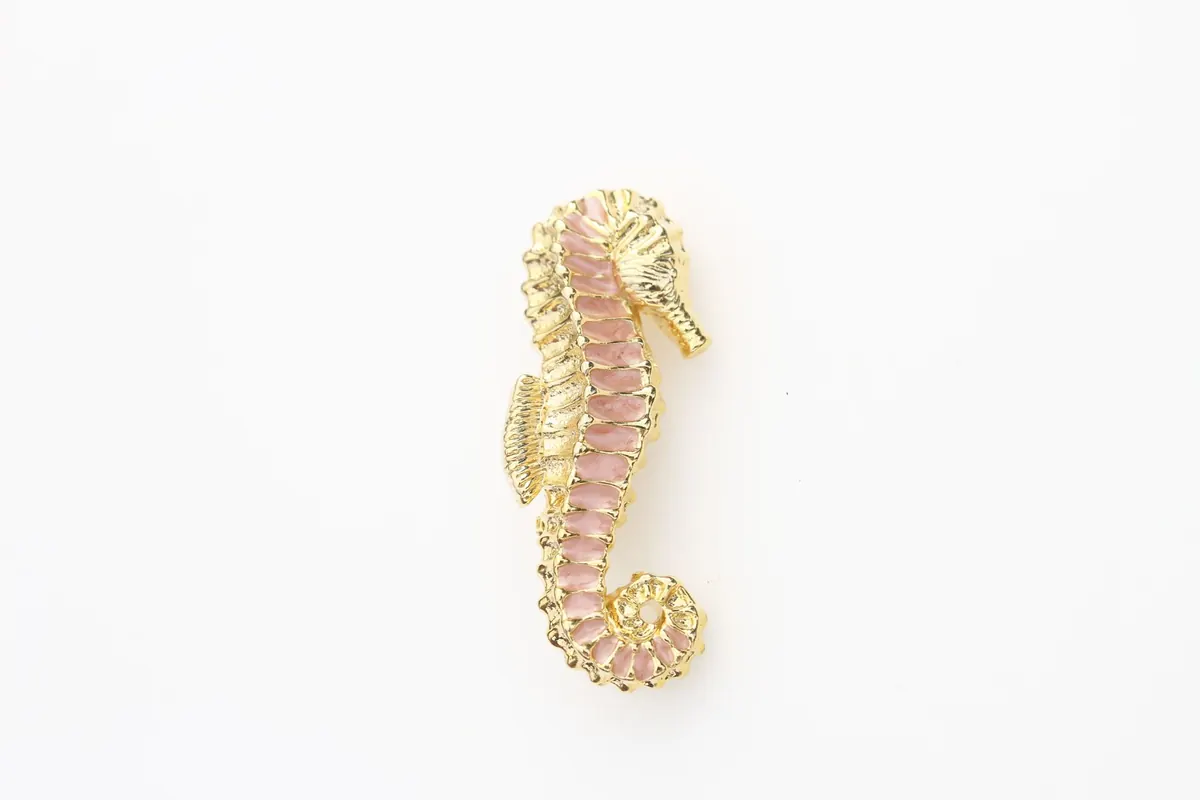
A brooch with no hallmark is not a brooch without a story. It is simply one that has stopped telling it in the easiest way. Turn the piece over in your hand and look at the back before you decide anything. The front is what the maker wanted you to see; the back is where the century shows.
Makers' marks are useful, but plenty of excellent brooches were never signed, and plenty of signed ones have been repaired, re-set or reassembled over the decades. What rarely lies is hardware. Clasps, pins and settings were made in particular ways at particular times, and once you know the rough sequence, you can place most unsigned brooches within a decade or two.
Start with the clasp
The catch is the single most revealing piece of metal on a brooch. It is also the part most likely to have been replaced, so read it alongside everything else rather than in isolation.
The C-clasp
A simple C-shaped hook that the pin presses into. This is the oldest catch you are likely to meet, in use broadly from the mid-nineteenth century into the 1930s. Early versions are tight and closed, often no more than a curve of metal. As the decades passed, the opening widened, and by around 1900 many examples had a small lever or extension so the pin could not slip out. A plain, closed C-clasp with no safety element suggests a date before 1900; a wide, open one with a safety lever points later, roughly 1900 to 1930.
The trombone clasp
A tube that slides into a sleeve, rather like the instrument. You will find these on brooches from around the 1850s to the 1920s, and they are especially common on Continental European work and on gold pieces. Do not read it as a sign of cheapness; it was a neat, secure fitting used on good jewellery.
Rollover and safety catches
The catch that swings over the pointed end of the pin appeared around 1900 and is still made today, so on its own it tells you very little. Use it as a tiebreaker. A rollover catch with a long pin and hand-set stones sits comfortably in the early twentieth century; the same catch with glued stones and a stubby pin belongs much later.
Modern fittings
Bullet or butterfly backs, and rotating locking catches stamped as part of the backplate, are twentieth-century inventions that became common from the 1950s onwards. They are the usual sign of a brooch made in the 1960s, 1970s or 1980s.
Read the pin stem like a ruler
The sharp pin itself is a surprisingly good dating tool, because its length was dictated by fashion. Victorian and Edwardian brooches were pinned through wool, boned bodices and heavy coats, so their pins were long and often extended well past the edge of the brooch. That generous overhang continued into the 1920s, 1930s and 1940s. By the 1950s pins had shortened, and from the 1970s onwards the pin frequently stops short of the brooch's edge altogether, hidden behind the decorative front.
Look at the metal, too. On gold brooches made before the twentieth century, it is common for the pin stem to be a harder metal such as steel, because gold bends too easily to make a reliable pin. A gold-toned pin on a gold brooch usually means either a later piece or a replacement.
Judge the materials
Stones give themselves away through their setting. Closed-backed, foiled rhinestones, where the sparkle comes from a metallic foil behind the stone, belong mostly to the period before around 1940. Open-backed stones, where you can see through the setting from behind, became standard from the 1940s onwards. Glued stones rather than prong-set ones are a strong sign of the 1950s and later; if you can see dried adhesive, look late.
Plastics can be dated with a little care. Test on a hidden area, never on painted or enamelled surfaces, and use warmth from your thumb rather than hot water, which can cloud some finishes.
- Celluloid: from the 1860s and 1870s. Warm it and it gives off a faint camphor smell.
- Casein, often sold as Galalith: from the 1890s. Rub it hard and it smells of burnt milk. Usually opaque and slightly milky.
- Bakelite and Catalin: patented in 1907, but used for jewellery mostly in the 1930s and 1940s. Friction releases a sharp, chemical, medicinal note.
- Lucite and later acrylics: from the 1930s onwards. No smell, lighter in the hand, often clearer.
Study the construction
Older brooches are usually assemblies. The clasp, the hinge and the pin are separate pieces of metal, riveted or soldered to the back, and you can often see the rivets, the solder seams and the file marks where someone tidied the joint. Later brooches are often struck from a single sheet, so the backplate, catch and hinge are all one piece with no visible joins.
Look also at how the decoration was applied. Hand-painted or softly pounced enamel, hand-set stones in individual metal collets, and slightly irregular spacing all point earlier. Uniform, sprayed finishes, glued stones and perfectly even rows tend to point later. Screws are a small giveaway as well: slotted heads suit older work, while uniform cross-head screws are a twentieth-century convenience.
Let the style confirm the hardware
Design is the least reliable clue, because revivals are everywhere, but it is excellent for confirming what the back has already told you.
- Victorian: jet, cameos, mourning pieces, black glass, insects and botanical motifs.
- Art Nouveau, roughly 1890 to 1910: whiplash curves, flowing lines, enamelled surfaces.
- Edwardian, 1901 to 1910: delicate and lacy, pale metals, small stones, light construction.
- Art Deco, 1920s and 1930s: geometric shapes, chrome, mirror glass, strong colour contrast.
- 1930s and 1940s: Bakelite, patriotic motifs, large clear rhinestones.
- 1950s: enamelled flowers, rhinestone sprays, coloured stone fruit designs.
- 1960s and 1970s: bold plastics, bright colour, abstract shapes.
- 1980s: oversized gold-tone pieces with generous crystal.
What can throw you off
Repairs are the main trap. Clasps and pins are replaced constantly, so a shiny modern catch on an old brooch means nothing more than a good jeweller once did a sensible job. Watch for solder blobs, added glue and stones that do not match the rest of the piece. Be suspicious of mismatches in wear: if the metal is worn smooth but the stones are flawless, something has been swapped.
Over-polishing is common too. A much-buffed brooch loses the crisp edges and fine detail that help you date it, and it can be hard to tell heavy polishing from a modern casting.
A simple routine to follow
- Photograph the front and back in daylight, with a close shot of the clasp and pin.
- Date the clasp and pin first and write down the range they suggest.
- Check the stones: closed or open backed, prong-set or glued.
- Identify the material if you can, using a discreet rub test.
- Note construction details: rivets, solder, separate findings, even spacing.
- Compare all of that with the style, and settle on the narrowest period where the clues overlap.
- List anything that looks replaced, and treat the result as a range, not a date.
Dating without a hallmark is an exercise in weighing evidence. One clue proves nothing; four clues that agree are surprisingly persuasive. A closed C-clasp, a long pin, hand-set stones and Art Nouveau curves land you in the same decade from four different directions.
If the brooch might be precious metal or set with real gemstones, or if you are buying with money rather than curiosity at stake, have it looked at by a jeweller or a reputable auction house before you rely on your own reading. Handling a piece in person beats any set of rules, including these.
Photo: Inga Engele / Pexels